
Wholesale Distribution ERP on Business Central
How Business Central + dvstock + dvlogistic covers wholesale distribution: inventory, WMS, B2B portal and AP automation. Real KPIs, real numbers.
Wholesale Distribution ERP on Microsoft Dynamics 365 Business Central, deployed by Davisa — Microsoft Solutions Partner for Business Central since 2003
Wholesale distribution is a margin-thin, volume-heavy business where the ERP is not a back-office tool — it is the operating system. If your inventory layer, warehouse layer and customer-facing channels are not on the same data model, you are paying for the gap every single day in misaligned KPIs, manual reconciliations and lost sales.
This article covers what a Business Central-based distribution stack actually looks like in 2026: which layers are native, which are extended by dvstock, dvlogistic-almacen and dvcommerce, what realistic numbers our client base shows, and what to watch for when migrating from SAP Business One or Sage X3.
The 4 KPIs a wholesale distributor must own
Distributors who win do not optimize 40 KPIs. They obsess over four:
- Inventory turnover (cost of goods sold / average inventory). Industry baselines vary by segment — 4–6 in industrial distribution, 8–12 in fast-moving consumer durables, 12–20 in food service. Anything materially below your sub-segment benchmark is working capital wasted.
- OTIF (on-time, in-full). The single best predictor of customer retention in B2B distribution. World-class is 95%+. Most distributors we audit start at 78–86%, which is far worse than they realize, because they measure on-time and in-full separately.
- Fill rate at the line level (lines shipped complete / lines ordered). Different from OTIF. Tracks the upstream supply problem: are you out of stock when customers want to buy?
- Gross margin per SKU, refreshed weekly with landed cost. The killer KPI nobody calculates correctly because freight, customs and supplier rebates land in the GL detached from inventory cost. Once it is wired correctly, 20–30% of SKUs typically reveal themselves as margin-negative.
If your current system cannot give you these four KPIs in real time, that is the brief for the ERP replacement, regardless of vendor.
Inventory optimization layer
dvstock is the demand intelligence layer on top of Business Central inventory. Three capabilities that move the needle:
ABC-XYZ classification. SKUs are scored on revenue (A/B/C) and demand variability (X/Y/Z) on a rolling 13-week window. AX items (high revenue, predictable) get tight safety stock and JIT replenishment. CZ items (low revenue, erratic) get reviewed for delisting or made-to-order. The classification updates automatically; no manual review cycles.
Dynamic reorder points. Standard ERPs use static min/max. dvstock calculates reorder points from rolling demand, supplier lead time and lead-time variability per item-supplier pair. When a supplier slips, the reorder point automatically rises. When a SKU’s demand collapses (seasonal end, product end-of-life), it falls. The buyer’s job becomes managing the 5% of exceptions, not the 100% of replenishments.
Demand forecasting. Statistical forecasting (Croston for intermittent demand, Holt-Winters for seasonal, ARIMA for trended) at the SKU-warehouse level. Forecasts feed the reorder points and S&OP reviews. Override-and-track tracking shows which forecasts beat the planner and which planner overrides beat the model.
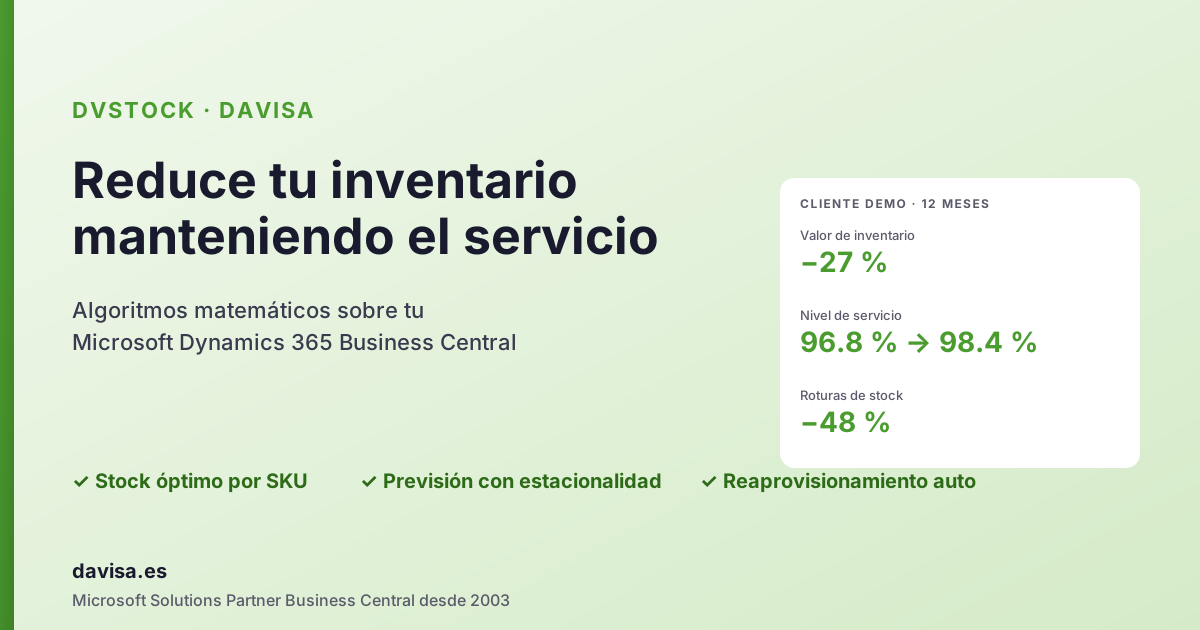
The honest number from our client base: 20–30% reduction in working capital tied up in inventory within 9 months of go-live, while simultaneously improving fill rate by 4–8 percentage points. The ROI is rarely the software cost — it is the working capital released.
See dvstock technical sheet — Use the dvstock ROI calculator
Warehouse operations (WMS) layer
dvlogistic-almacen is the WMS extension on Business Central. It adds the physical-warehouse capabilities standard BC stops short of:
- Radiofrequency-driven picking, putaway, replenishment on handheld terminals (Zebra, Honeywell, ruggedized Android). Each step is confirmed by scan, eliminating the “ghost stock” problem of paper-driven warehouses.
- FEFO/FIFO enforcement at the bin level, critical for food, pharma-adjacent and any expiring stock.
- Cross-docking for orders received against open backorders — material can be redirected from receiving dock to shipping dock without ever touching a putaway location.
- Slotting optimization: high-velocity SKUs migrate automatically toward picking faces; slow movers move to reserve. The slotting algorithm runs weekly and proposes rearrangements; the warehouse manager approves the move list.
- Wave and batch picking for multi-order optimization, including pick-by-light integration where the physical infrastructure exists.
A distribution center moving from paper-based to dvlogistic-almacen typically sees 30–50% productivity improvement on picking and 90%+ reduction in inventory accuracy errors, both quantifiable within the first cycle count after go-live.
B2B portal layer
dvcommerce is the B2B portal extension that consumes the same Business Central data — same prices, same stock, same customer terms — in real time.
What that means in practice:
- Customer-specific catalogs: each B2B customer sees only the assortment they are entitled to, with their contracted prices, their credit terms, and their stock allocation if applicable.
- Real-time stock per warehouse, with availability dates for backordered items pulled from open POs.
- Quick reorder from past orders, favorites lists, and uploaded order CSV — the workflows distributors actually need, not a B2C-grade Shopify experience repurposed for B2B.
- Quote-to-order workflow for items requiring sales rep involvement, with quote expiration and conversion tracking.
The conversion uplift is real but the mechanism is more interesting than the headline number: portals do not create new demand, they shift order capture from inside-sales staff to the customer, freeing the sales team for activities they did not have time for before — proactive account management, dormant-customer reactivation, cross-sell on top of self-serve baseline orders.
See dvcommerce technical sheet
AP automation
Distributors process a lot of supplier invoices — typically 3–8x the volume of an equivalent-revenue manufacturer. dvinvoice-hub adds OCR plus rules-based matching plus exception workflow on top of standard Business Central AP.
A distributor receiving 1,200 supplier invoices/month with manual AP usually allocates 2 FTEs to invoice processing. After dvinvoice-hub stabilizes (month 3–4), the same volume runs through 0.5–0.7 FTE, with 75–85% straight-through processing and humans focused on the 15–25% of exceptions that need judgment.
Real numbers from Davisa client base
Ranges averaged across the last 12 wholesale distribution implementations Davisa has completed:
- Inventory working capital reduction: 20–30% within 9 months (dvstock).
- Fill rate improvement: +4 to +8 percentage points (dvstock + dvlogistic-almacen).
- Warehouse picking productivity: +30 to +50% (dvlogistic-almacen).
- Inventory accuracy: from ~92% to 99.5%+ within 6 months.
- B2B online order share: from baseline (5–15%) to 35–55% within 12 months (dvcommerce).
- AP processing FTE reduction: 40–65% at >800 invoices/month (dvinvoice-hub).
These are the ranges we put in writing in client proposals because they are what the existing base has delivered. Distributors coming from paper-and-Excel land at the high end; distributors coming from a mature SAP B1 land at the low end (less headroom to capture).
Migrating from SAP B1 or Sage X3
The honest playbook for a distributor migrating from either platform:
Timeline. A typical migration for a 50–150-user distributor runs 8–12 months from kickoff to cutover. Master-data cleanup is the longest path: 10+ year-old SAP B1 and Sage X3 instances accumulate duplicate customers, deprecated items and inconsistent unit-of-measure conventions. Plan 2–3 months of data work before configuration starts.
Gotchas.
- Pricing structures. Both SAP B1 and Sage X3 have sophisticated pricing engines. Business Central’s native pricing is good but different. Recreate the price model intentionally during analysis, not by reverse-engineering during testing.
- Custom reports. Most distributors have 30–80 critical, undocumented Crystal Reports or SAP B1 layouts. Inventory them early, prioritize ruthlessly, rebuild only the top 20% in Power BI.
- Integration surface. EDI, carrier APIs, marketplace connectors — none of them migrate. Map the integration landscape in week 1.
- User adoption. Plan for a 30–50% productivity dip in the first 4–6 weeks post-go-live and build it into the operational plan.
TCO. For a 100-user distributor, 5-year TCO on Business Central plus dv* extensions typically lands 25–40% below an equivalent SAP B1 setup with comparable third-party add-ons, and broadly comparable to Sage X3. The economics are not the main argument for migration; the unified data model is.
Next step
If you are running a wholesale distribution business on a stack older than 8 years, or piecing together best-of-breed tools that no longer share a clean data model, the question is when, not if, you consolidate. Talk to Davisa before talking to vendors — we will tell you whether your current pain justifies the project or whether a targeted fix beats a full migration.