
Family Office: The 10 Capabilities of an Excellent Team
Ten operational capabilities that distinguish the team of a serious Family Office, and how dvproject-patrimonio on Business Central supports them every day.
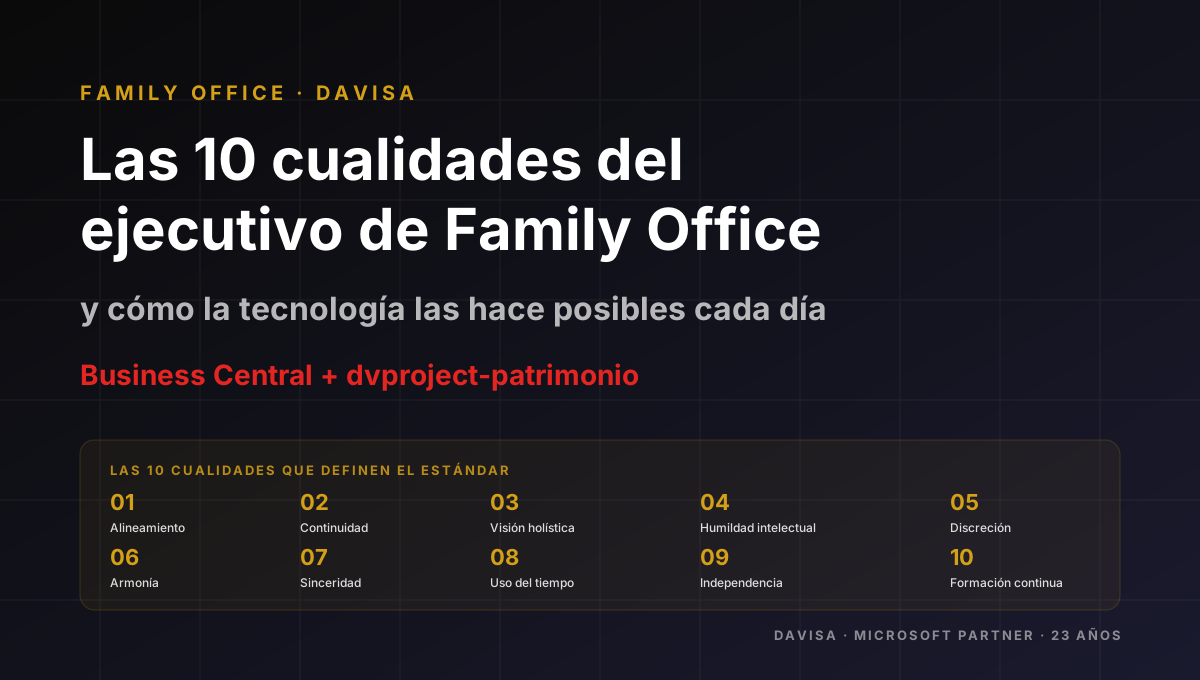
Working in a Family Office is unlike other professional environments. The pressure doesn’t come from the market, it comes from knowing that the decision taken today affects people who are probably not in the room — including some who haven’t been born yet. That peculiarity explains why the good Family Office teams share a common pattern in how they work, and why those who improvise always end up in the same problems.
At Davisa Informática we have been implementing Microsoft Dynamics 365 Business Central + dvproject-patrimonio in family wealth structures and private offices for more than two decades. What follows are the ten capabilities we see separating the team that sustains the wealth from the one that merely administers it. Each one includes a note on where the tool matters and where it doesn’t: because some aspects are transformed at the root by technology, and others depend exclusively on people. Being honest about that boundary saves disappointments.
1. Treat someone else’s wealth with the discipline it deserves
The first trait of a good Family Office executive is to assume that they are looking after something that isn’t theirs. It sounds obvious, but the practice is demanding: it means deciding as the Principal themselves would decide if they were across every detail, and resisting the drift of “I already know what is best”. The taste for service, for the fulfilment of the other as a path to one’s own, marks that difference from day one.
Technology doesn’t manufacture that character. What a serious platform does is turn personal discipline into structural discipline: decisions are recorded with author and reason, approval flows force the significant to be documented, the Principals have direct visibility over what happens with their wealth. What depended on individual honesty becomes also dependent on a verifiable process, which is how it should be.
2. Work with a generational horizon, not a close-of-period one
The most common mistake in a Family Office is to manage with the wrong calendar. The quarterly bonus, the annual account, the sector ranking: none of those references serves when the goal is for the wealth to reach the grandchildren of the grandchildren intact. The right horizon is measured in decades, and that changes the type of risks accepted and the bets sustained even when they don’t shine in the short term.
To manage with that horizon you need institutional memory, and here technology is decisive. If the historical return per asset, the evolution of typologies, the real costs per property or the behaviour of each vehicle live in spreadsheets that change hands at every team handover, there is no possible continuity: every generation starts from zero. An integrated database accumulates that history and makes it available to whoever comes next. The family inherits the wealth and the know-how to manage it, which is what truly preserves it.
3. See the full play before moving a single piece
Every major movement in a Family Office branches into five dimensions at once: financial, tax, legal, succession and reputational. Whoever decides without having all five in view ends up discovering, six months later, a consequence they didn’t anticipate — and it is rarely pleasant. Holding the full play in your head is a mental discipline that takes years to train; having it visible on a dashboard is something else, much more sustainable.
When finance lives in one program, properties in another, contracts in SharePoint and taxation in the external adviser’s head, the integrated view is impossible even if the executive theoretically holds it. dvproject-patrimonio on Business Central consolidates assets, group companies, contracts and tax reporting in a single panel, and connects natively to Power BI for advanced analysis, SharePoint for documentation and Teams for coordination. The holistic capability stops depending on one person’s memory and becomes a property of the system.
4. Accept that conviction is not the same as being right
Markets punish arrogance hard, and a Family Office acts under conditions of incomplete information almost by definition. The difference between a team that lasts and one that stumbles lies in the capacity to review their own thinking without taking it personally: admitting that the thesis from two years ago didn’t play out, that an analysis left variables out, that the next decision needs more data.
The tool doesn’t produce humility; that is produced by character and by the family’s culture. But a good system puts in front of you the facts that ground it. When a dashboard shows that the real performance of a decision was below the forecast, the conversation in the committee changes: the opinion is no longer the subject, the data is. That honest friction between the comfortable narrative and the measured reality is the best operational school we know to keep feet on the ground.
5. Sustain confidentiality with technique, not just with discretion
A Family Office handles information that should never leave the structure: composition of the wealth, succession planning, corporate structure, pending decisions. The personal discretion of the team is a necessary condition but not sufficient; what is truly decisive is how the information is protected at the technical level.
A spreadsheet shared by email, a folder without fine-grained permissions, an on-premise server managed by someone who leaves: each of those is a real exposure surface. Business Central, on which dvproject-patrimonio lives, operates with encryption in transit and at rest, mandatory multi-factor authentication, granular role-based permissions, audit logging of every access and enterprise certifications such as ISO 27001 and SOC 2. Professional discretion goes from being a personal virtue to being backed by a technical system that makes it hard to do things badly even if someone wanted to.
6. Build a team that works without internal friction
A well-run Family Office is also a place where people want to work. The relationships inside the team and between the team and the Principals need a difficult balance to formulate: enough formality to keep the roles clear, enough closeness for daily life not to be a burden. When that harmony fails, turnover spikes and the loss of knowledge is paid for years.
Harmony is built by people, but systems have a modest and real role: eliminate the operational friction that corrodes it. Arguing whether an invoice has been paid when everyone has the data on screen, debating which version of the spreadsheet is the good one when there is a single source, spending hours assembling a report that already exists in Power BI. Each of those micro-frictions is a point where the working relationship wears down. Removing them doesn’t guarantee a good atmosphere, but it protects the good atmosphere that already exists.
7. Tell the truth even when it’s uncomfortable (and be able to prove it)
The Principal of a Family Office cannot be treated like a client whose message gets softened. They need raw information, without added filters, including the errors and the uncertainties. That candour requires professional courage — but it also requires information that is actually accurate, because if what reaches the Principal went through three intermediate spreadsheets, what they receive is no longer reality but a construction that happened to reconcile in the last glance.
Here technology makes a subtle but radical difference. When the Principal’s dashboards pull the source data directly from the system, without intermediate manual steps, embellishing stops being an option even if someone tried. Honesty is no longer just a professional commitment, it is the only exit from the information flow. For a long-term trust relationship, that is worth its weight in gold.
8. Defend the team’s time as a scarce asset
In most Family Offices the team is compact. Two, five, eight people carrying broad and very varied responsibilities. Their time is, almost always, the real bottleneck of the organisation — more than capital, more than opportunities. Whoever manages that time with judgement is the one who decides whether the team devotes its hours to what is important or to putting out administrative fires.
Here the difference between an integrated platform and a collection of loose applications is vast. A team working with parallel spreadsheets spends between 40% and 60% of its time collecting before analysing: requesting the data, reconciling it, validating it, exporting it. When that operation lives in BC + dvproject-patrimonio, the collection is automated and the Family Office’s most expensive asset is freed for what truly adds value: thinking, deciding, talking with the Principals, anticipating moves. Automation in this context isn’t there to reduce headcount; it is there so the existing headcount works on what they know how to do.
9. Anticipate instead of react
A good Family Office executive identifies the problem or the opportunity before anyone has to point it out. And once the collegial decision has been taken, implements it with discipline even if it doesn’t fully match their personal opinion. That combination of initiative and professional obedience is rare and very valuable.
Technology doesn’t generate initiative, but it multiplies the field of vision of whoever has it. Automatic alerts for contracts expiring in 90 days, notices of pending CPI review, KPIs straying from the usual range, tax deadlines in queue: a well-parameterised system turns the team into a proactive one even when the operational load is high, because it points out what needs to be looked at. And the documented approval workflows reinforce the other half: what was decided is recorded and executed without depending on who remembers what.
10. Stay up to date without having to run a project
Markets change, regulations reinvent themselves every legislature, families evolve. The professional who stops learning stops being useful — and in a Family Office, where the team is small and the responsibility broad, that shows up quickly. Continuous training isn’t an add-on, it is part of the mandate.
The platform doesn’t teach, but a good infrastructure frees the time that training needs (see point 8) and updates itself in its capabilities. When Business Central incorporates Copilot, when Power BI adds analysis features, when dvproject-patrimonio adapts modules to a new regulation (IFRS 16, Verifactu, Crea y Crece), the family inherits the improvement without having to face a project every time. Staying current demands less effort when the technical base is alive by default.
What remains when the ten add up
The ten capabilities above aren’t a checklist. They are traits that reinforce each other: the team that respects time is the same one that decides with humility, the one that protects confidentiality with technique is the same one that reports with candour. Together they define a professional standard that is much harder to manufacture than any tool — but that any tool can help protect.
At Davisa we see it every day. Tools don’t replace the character of a good Family Office executive. What they do is protect that character from the friction that wears it down over the years: the scattered information that erodes candour, the parallel spreadsheets that corrode the use of time, the disconnected systems that blind the integrated view, the opaque permissions that compromise discretion. A good platform isn’t a solution; it is an infrastructure that allows things to keep being done well even when the pressure tightens.
If you manage a Family Office and you recognise yourself in any of these ten capabilities, I’d propose a conversation. No packaged proposal, no catalogue presentation. A diagnostic session to understand what friction your operation has today and whether it makes sense to keep talking. Schedule a conversation with our dvproject-patrimonio team →
Isabel Arruebo Ginto — Co-founder of Davisa Informática. More than 20 years supporting business families and Family Offices in the professional management of their wealth with Microsoft Dynamics 365 Business Central and dvproject-patrimonio.
Artículos relacionados
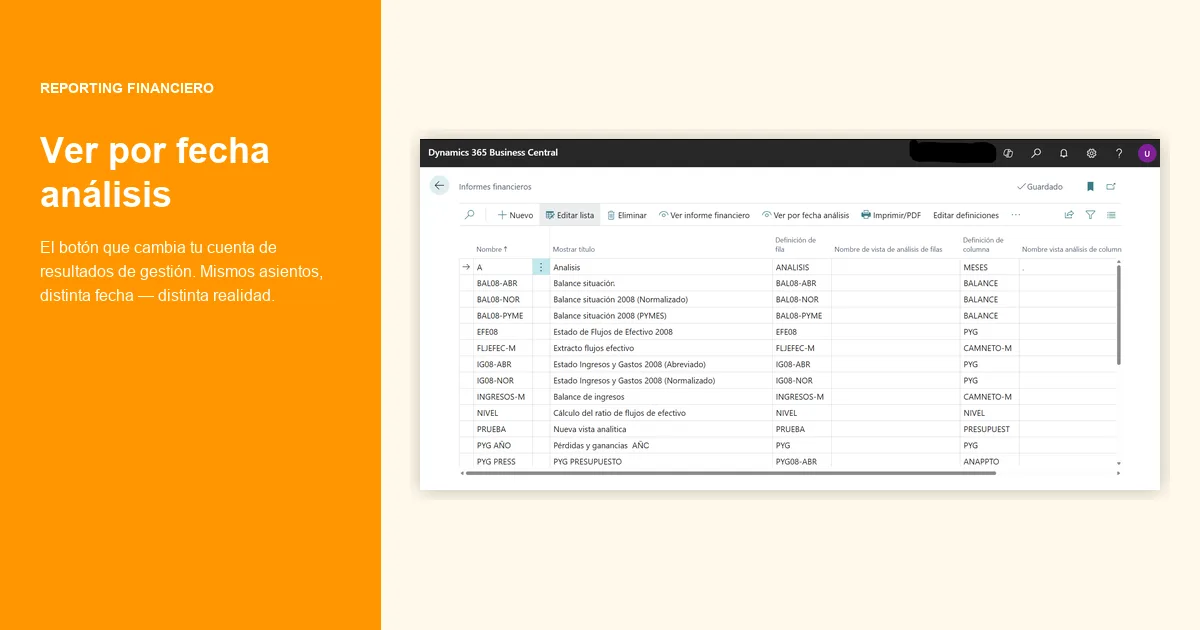
Accrual vs Invoice-based P&L Reporting in Business Central
Accrual vs invoice date in the monthly P&L: numerical examples of how monthly margins shift depending on which closing criterion you use.

AP Automation ROI in Business Central: Real Numbers
Where AP teams burn time, the 5 ROI buckets of AP automation, real Davisa client ranges, and typical 9-14 month payback for 800+ invoices/month.

Multi-Currency Consolidation in Business Central
How groups handle currency translation, intercompany and IFRS reporting in Business Central — and where dvfinance + dvdata-analysis extend the core.