Fracttal, Maximo & Mainsaver vs dvgmao: CMMS in BC
Top CMMS platforms (Fracttal, Maximo, Mainsaver, MaintainX) compared with dvgmao, the native Business Central option. When each one fits.
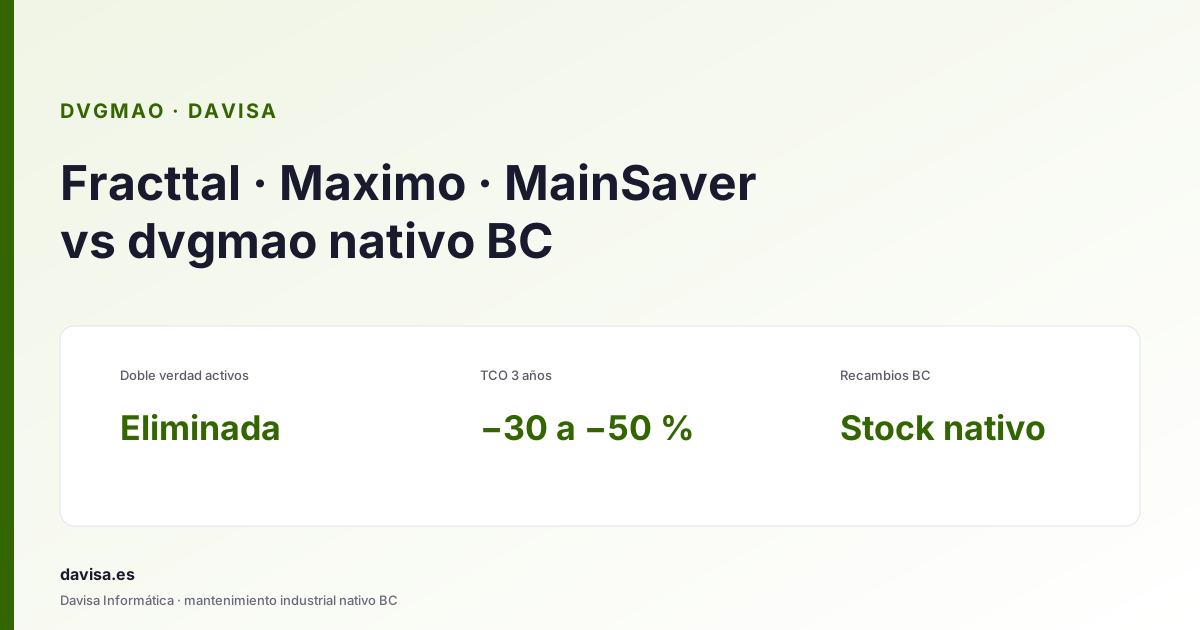
If your company runs Microsoft Dynamics 365 Business Central and you are evaluating a maintenance management tool (CMMS / EAM), you’ve come across a market full of options — and all of them claim to be the best.
This article compares, without sugar-coating, the most popular CMMS platforms among Spanish industrial companies — Fracttal, IBM Maximo, Mainsaver, MaintainX — against dvgmao, Davisa’s native Business Central CMMS extension.
Context disclosure: dvgmao is a Davisa Informática product. We’ve worked to keep this comparison objective. When a competitor is the right fit for your case, we say so.
Summary table — 5 real options
| Dimension | Fracttal | IBM Maximo | Mainsaver | MaintainX | dvgmao |
|---|---|---|---|---|---|
| Origin / positioning | Chile/Spain, modern SaaS | IBM, enterprise EAM leader | USA, classic CMMS | USA, mobile-first SaaS | Spain, native BC extension |
| Target companies | SMEs and mid-market | Large enterprise industry | Industrial SMEs/mid-market | Operations-heavy SMEs | SMEs/mid-market on BC |
| Integration with BC | Connector / API | Connector + middleware | Connector / file import | REST API | Native AL, no connector |
| Mobile app for technicians | Yes (a strength) | Yes | Yes | Yes (a strength) | Yes (BC App / web) |
| Industrial IoT management | Yes | Yes, advanced | Limited | Limited | In development |
| Complex preventive plans | Yes | Yes, leader | Yes | Yes | Yes |
| Approx. pricing (15 technicians) | €5,400-14,400/year | €50,000-150,000/year | €8,000-25,000/year | €5,400-9,000/year | By quote |
| Spare-parts cost flows into BC inventory | Via sync | Via sync | Via sync | Via sync | Yes, native |
Fracttal — the modern Spanish-LATAM SaaS
Fracttal originated in Chile and has a strong presence in Spain. It is probably the SaaS most adopted by Spanish industrial SMEs migrating away from Excel. Its strengths: fast deployment (typically 4-8 weeks), modern UI, solid mobile app for technicians on the shop floor.
Where Fracttal fits well
- Industrial company without an ERP (or with an ERP that is unfriendly for maintenance).
- Distributed technical team that needs a powerful mobile app.
- Fast deployment, no multi-month project.
- Moderate asset volume (tens to a few hundred).
Where Fracttal falls short if you already run BC
- Dual source of truth for master data: the asset catalogue lives in Fracttal, the product catalogue (spare parts) lives in BC. When a technician swaps a spare part, consumption is recorded in Fracttal but BC stock is updated via sync. Discrepancies follow.
- Recurring connector cost with BC.
- Spare-parts purchasing: the technician raises a need in Fracttal, somebody pushes the order into BC. Double step.
IBM Maximo — the enterprise leader
Maximo is the historical EAM (Enterprise Asset Management) benchmark in heavy industry: refineries, chemical plants, automotive, energy, rail transport. One of the most mature tools in the world.
Where Maximo fits well
- Industrial multinationals with thousands of critical assets.
- 24/7 operations with high downtime costs.
- Industrial IoT integrated with SCADA/PLC machinery.
- Advanced maintenance subcontractor management.
- Strict regulatory compliance (ATEX, pharma, food).
Where Maximo does NOT apply to SMEs
- Prohibitive cost (€50,000-150,000/year + implementation).
- Oversized for companies with 50-500 assets.
- Typical implementation of 6-12 months.
Mainsaver and similar — classic CMMS
Mainsaver, eMaint and similar tools are classic CMMS platforms with a long track record. Good products, but they compete in the same space as Fracttal and MaintainX with less visible differentiation.
MaintainX — the mobile-first SaaS
MaintainX is probably the most “millennial” SaaS in this segment. Excellent mobile app, built-in internal communication (chat-style), fast deployment. It is growing fast in operations-driven SMEs, especially HORECA, retail and facilities services.
Where MaintainX fits well
- Companies with many decentralised physical sites (chains, franchises).
- Maintenance teams that live on mobile.
- More maintenance operation (corrective work plus simple plans) than critical industrial assets.
Where MaintainX falls short
- For heavy industry with complex assets, functional depth is limited.
- ERP connection is via basic API.
dvgmao — the native Business Central option
dvgmao is an AL extension inside BC, aligned with the Business Central Fixed Assets module. It is not a standalone product — it lives inside the ERP, built by Davisa with 20+ years on BC in Spain.
What it covers
- ✓ Asset catalogue (equipment, machinery, facilities) linked to the BC cost centre.
- ✓ Preventive plans per asset (frequency, tasks, assigned technicians).
- ✓ Work orders — corrective and preventive — with approval workflow.
- ✓ Spare-parts consumption that posts directly against BC inventory (no sync).
- ✓ Time posting for technicians as a BC
Resource(same model as Jobs). - ✓ Real cost per asset, integrated with BC accounting.
- ✓ Maintenance KPIs: MTBF, MTTR, availability, OEE.
- ✓ Power BI on top of the same BC database.
- ✓ Mobile app for technicians via BC Mobile.
What it does NOT need
- ✗ Connector with BC.
- ✗ Catalogue synchronisation.
- ✗ Dual source of truth for inventory / assets.
- ✗ Monthly reconciliation between CMMS and ERP.
Real 3-year TCO
Mid-sized industrial company (150 assets, 12 technicians, 1 BC tenant in Spain):
| Option | Approximate 3-year TCO |
|---|---|
| Fracttal | €16,000-40,000 (licence) + €8,000-15,000 (connector + integration hours) |
| IBM Maximo | €150,000-400,000 (licence) + €100,000+ (implementation) |
| Mainsaver | €24,000-75,000 (licence) + integration |
| MaintainX | €16,000-25,000 (licence) + integration |
| dvgmao | By quote, typically 30-50% lower than the cheapest SaaS option above |
Key drivers of dvgmao savings: zero connector with BC, zero recurring integration cost, zero monthly reconciliation, local Davisa team in Spain.
When to pick each one — straight talk
Fracttal → if you do NOT run BC, or you want a modern mobile app as priority #1 and accept the recurring integration cost.
Maximo → if you are an enterprise industrial multinational with thousands of assets.
Mainsaver → middle-ground case similar to Fracttal but more traditional.
MaintainX → if your operation is more about distributed physical sites (chains, franchises) than heavy industry.
dvgmao → if your ERP is Business Central and you want a single source of truth (assets + spare parts + costs + hours) with a lower TCO.
Real case: Fracttal → dvgmao migration
Davisa client (2024): industrial services company (facilities maintenance), 18 technicians, BC since 2019, Fracttal since 2022.
Before (Fracttal + BC connector)
- €10,500/year Fracttal.
- €4,000/year connector + middleware maintenance.
- 25-40 hours/month of reconciliation: spare parts consumed in Fracttal vs BC stock movements, technical hours vs BC Jobs posting.
- Total annual cost: ~€24,000.
12 months after dvgmao
- Total annual cost: −52% vs Fracttal.
- Monthly reconciliation: practically gone. What the technician posts in BC App is already on the BC job/work order.
- Real margin per customer service: visible in real time (previously calculated at month-end close).
- Spare parts out of sync: drops to zero (a single product master in BC).
Project ROI: < 10 months.
Closing — decide based on your company’s case
Fracttal, Maximo, Mainsaver and MaintainX are good products. For the profiles where they fit (multinational, no ERP, distributed physical sites), they are the reasonable choice.
For companies running Business Central as their ERP and a mid-sized industrial operation (most Spanish manufacturing SMEs), dvgmao eliminates the dual data layer and lowers the TCO without losing relevant functionality.
Want a firm comparison against your case (asset volume, technical team, complexity of preventive plans)? Talk to a Davisa advisor — within a week you’ll have a firm proposal.
Artículos relacionados

Business Central vs Custom ERP Development: Which Is Better?
Business Central with extensions or a custom-built ERP? If you're weighing which option fits your company best, keep reading.
Inventory Optimization in Business Central with dvstock
dvstock is a demand forecasting and inventory optimization extension for Business Central. Cut stockouts, excess stock and carrying costs.