Spain Tax Compliance Landscape 2026 for ERP
Verifactu, SII, TicketBAI and B2B e-invoicing explained for international groups with a Spanish subsidiary. Davisa, MS Partner since 2003.

If you run an international group with a Spanish subsidiary, the Spanish tax compliance landscape in 2026 is more demanding than in any of the last twenty years — and the pace of regulatory change has caught a lot of CFOs and tax directors by surprise.
This is a practical map of the four regimes that now coexist in Spain, who they apply to, and how a Business Central deployment with the right local extensions handles each of them. It is written for finance leaders sitting in headquarters who need to understand what their Spanish controller is actually dealing with.
The 4 regulatory pillars in Spain 2026
Spain does not have one e-invoicing or fiscal-reporting regime. It has four, and they overlap.
1. Verifactu is the default invoice-issuance control system, regulated by Royal Decree 1007/2023 (developed from the 2021 Anti-Fraud Law). Every invoice generated by certified billing software must produce a structured XML record, hash-chain the previous record, and either be submitted to the AEAT immediately (the “Verifactu” mode) or stored locally with full audit traceability (the “no-Verifactu” mode, with stricter on-premises requirements). It applies to most companies and self-employed professionals not already inside SII or a foral territory. Effective dates: 1 January 2026 for Corporate Income Tax companies, 1 July 2026 for the rest.
2. SII (Suministro Inmediato de Información del IVA) has been mandatory since 2017 for large companies (turnover above 6 million EUR), VAT groups, and REDEME (monthly refund registry) registrants. It requires sending invoice records to the AEAT within 4 working days. Companies inside SII are excluded from Verifactu.
3. TicketBAI is the foral equivalent for the three Basque historical territories (Bizkaia, Gipuzkoa, Álava). It predates Verifactu and is fully operational, with territory-specific XML schemas, hash chaining, and submission endpoints. Navarra has its own version, also fully active. If your registered tax address is in one of these territories, the foral regime overrides the state regime.
4. Mandatory B2B electronic invoicing comes from the Crea y Crece Law of 2022. It requires every B2B invoice between companies and self-employed professionals to be exchanged in a structured electronic format. The implementing regulation is still pending publication at the close of 2026; the committed phased rollout starts 12 months after publication for companies above 8 million EUR turnover, and 24 months for everyone else.
These four pillars are not alternatives — they are layered. A medium-sized company in Madrid will likely face Verifactu plus B2B e-invoicing. A large group with a VAT group will face SII plus B2B e-invoicing. A subsidiary in Bilbao will face TicketBAI Bizkaia plus B2B e-invoicing. Each combination has its own technical fingerprint.
Verifactu vs SII: which applies to your subsidiary
The boundary between Verifactu and SII is sharper than it looks in the press, and getting it wrong is the most common mistake we see in 2026 projects.
SII applies if the entity meets at least one of these criteria:
- Annual turnover above 6,010,121.04 EUR in the previous year.
- Is part of a VAT group (régimen especial del grupo de entidades).
- Is registered in REDEME (the monthly VAT refund registry).
- Has voluntarily opted into SII (rare, but legal).
Verifactu applies if the entity is not in SII, not in a foral territory, and is subject to Spanish invoice issuance obligations. The default deadline is 1 January 2026 for IS companies and 1 July 2026 for everyone else, although extensions and exceptions for specific sectors continue to appear.
A common scenario: a foreign group has a Spanish subsidiary that historically turned over 4-5 million EUR (below SII threshold), grew above 6 million in 2025, and now has to switch regime in 2026. The transition is not optional — it is automatic — and the ERP needs to support both flows because the regime can switch year over year if turnover fluctuates around the threshold.
Foral systems: Basque country (TicketBAI), Navarra
The three Basque historical territories and Navarra have their own corporate income tax, VAT and invoice-control regimes. This is not administrative decentralization — it is fiscal sovereignty rooted in the Spanish Constitution’s first additional provision, and it produces real technical differences:
- Bizkaia (BATUZ): combines TicketBAI with LROE (ledger of economic operations) and a pre-calculation of corporate income tax called Modelo 140.
- Gipuzkoa: TicketBAI with quarterly reporting and a slightly different XML schema.
- Álava: TicketBAI with submission timing and validation rules closer to Bizkaia but not identical.
- Navarra: own e-invoicing regime modeled on TicketBAI but managed by Hacienda Foral de Navarra, with distinct endpoints.
For a Business Central deployment, this means each foral company needs its own configuration profile — same product, different submission setup, certificates, and ledger output. A group that operates in both common and foral territory has to maintain both Verifactu (or SII) and TicketBAI flows side by side.
How native BC extensions handle each regime
Davisa has been a Microsoft Solutions Partner for Business Central since 2003, and Spanish localization has been a constant theme across that time — the four regimes above are the latest layer in a regulatory history that started with FACe (B2G e-invoicing) in 2015.
The native approach used by dvimpuestos and dvfactura-e covers the four pillars from inside the standard BC document flow, with no external connectors:
- Verifactu: hash chain on every sales invoice posting, AEAT XML generation and webservice submission, fallback to “no-Verifactu” mode with local audit storage.
- SII: invoice and intra-community books, automatic submission within 4 working days, error reconciliation, and substitution flow for rectifying invoices.
- TicketBAI: foral-specific configuration per company (Bizkaia, Gipuzkoa, Álava, Navarra), certificate management, LROE reporting for Bizkaia entities.
- Factura-e and B2B e-invoicing: XML+XSIG signing, FACe submission for the public sector, and Peppol-ready output for the upcoming B2B mandate.
The architectural advantage of doing this natively (rather than through a tax middleware) is that the same invoice posting triggers the local fiscal flow without parallel reconciliation. The integration tax — keeping two systems in sync after every correction, rectification, or month-end adjustment — is the part that bleeds project hours in middleware setups.
For groups already on Business Central elsewhere, this means the Spanish subsidiary can run on the same tenant as the rest of the group, with company-level configuration applying the correct regime. For groups on SAP, Oracle or NetSuite globally, the typical pattern is to run the Spanish entity on Business Central as a satellite ERP, with master data integration to the corporate system.
Compliance roadmap 2026-2027 for international groups
A realistic compliance calendar for a foreign group with one or more Spanish entities:
Q1-Q2 2026: confirm regime per entity (SII / Verifactu / TicketBAI), audit current invoice-issuance software for compliance, run a master-data quality assessment (VAT IDs, foreign customer identifiers, NIF-IVA validations, electronic addresses for B2B e-invoicing).
Q3 2026: deploy the chosen technical solution. For most foreign groups this is either a Verifactu/SII certified module on the existing ERP, or a migration of the Spanish entity to Business Central with native Spanish localization plus dvimpuestos / dvfactura-e. Parallel period of at least one full month before cutover.
Q4 2026 - Q1 2027: monitor first quarters under the new regime, refine rectifying-invoice processes, train the local team on the new exception flows (regimes shift error handling from month-end to invoice-by-invoice).
Q2-Q4 2027: prepare for B2B e-invoicing rollout once the implementing regulation is published. The Peppol-ready architecture put in place during 2026 should absorb this with minimal additional work if the master data is clean.
The single biggest predictor of project success we see across 2026 deployments is the quality of customer and supplier master data exported from the corporate ERP. If electronic addresses, VAT IDs and country codes are clean, the Spanish compliance flows are routine. If they are dirty — and after 20 years of group consolidations they often are — the project becomes a master-data cleanup with a compliance deadline attached.
Spanish tax compliance in 2026 is not a one-off. It is the new baseline for every entity operating in Spain, and the ERP architecture decisions made this year will shape the next decade of local reporting.
Artículos relacionados
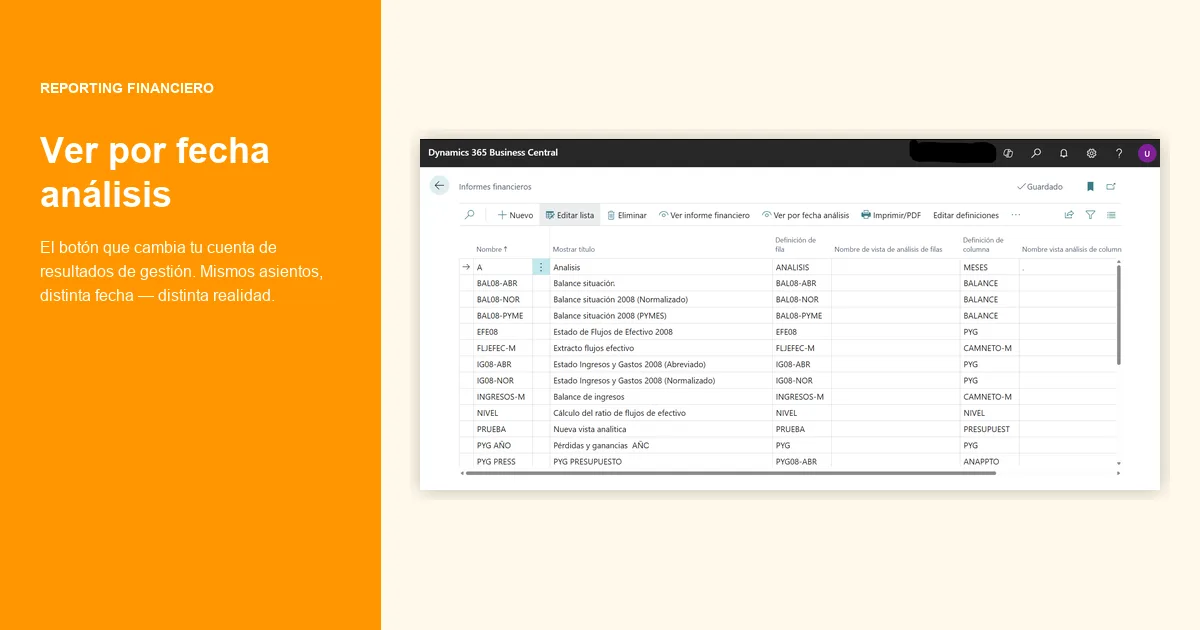
Accrual vs Invoice-based P&L Reporting in Business Central
Accrual vs invoice date in the monthly P&L: numerical examples of how monthly margins shift depending on which closing criterion you use.
AP Automation ROI in Business Central: Real Numbers
Where AP teams burn time, the 5 ROI buckets of AP automation, real Davisa client ranges, and typical 9-14 month payback for 800+ invoices/month.

Multi-Currency Consolidation in Business Central
How groups handle currency translation, intercompany and IFRS reporting in Business Central — and where dvfinance + dvdata-analysis extend the core.