
5 CFO Processes Where AI Pays for Itself in 6 Months
Five finance processes where AI is mature today, with measurable 6-month ROI on Business Central, dvinvoice-hub and dvfinance — no organisational revolution required.
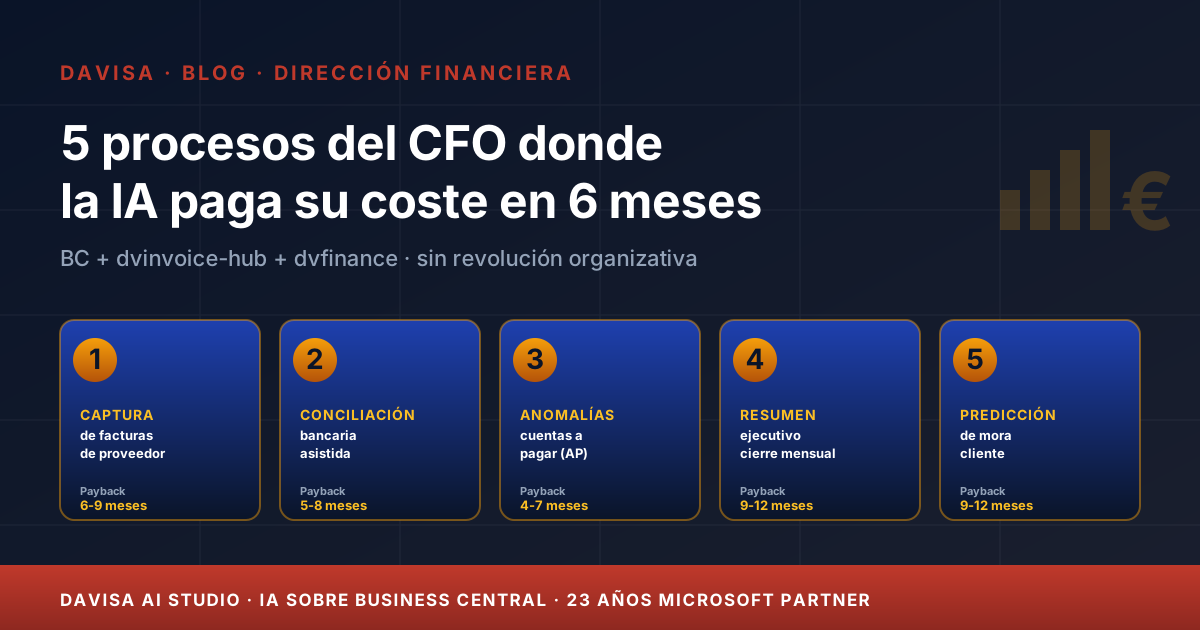
CFOs are paid to make few decisions well. Jeff Bezos said it and we picked it up in our post on AI in Business Central and financial decisions. To reach those few well-made decisions, the CFO needs the daily operation — the part that does not require their judgement — to run without consuming team time. That is where AI delivers today.
This article lists five CFO processes where AI is already mature in 2026 and where ROI is measurable in 6 months depending on volume. It is not a futurist manifesto. It is what is already running in real customers on Business Central, dvinvoice-hub, dvfinance and the custom AI layer built by Davisa AI Studio. None of these five processes requires changing ERP, refounding the finance department or buying three new licences per user.
At the end of the post, an honest section on what AI does not solve in finance today and that is worth acknowledging before signing anything.
The criteria: why exactly these five?
Before diving in, it is worth pinning down the criteria we apply when picking the five. Each one meets four conditions:
- Recurring, measurable pain in most mid-sized companies (not a niche case).
- Mature technology: proven models and patterns in real customers, not just academic pilots.
- Measurable 6-month ROI depending on volume, with a clear methodology: time saved, errors avoided, decisions accelerated.
- Reasonable adoption: the existing finance team can use it without heavy training and without reshuffling the org chart.
Out of scope: processes where AI is still in promise mode (strategic forecasting, M&A decisions) or where real saving depends more on accounting tidiness than on technology (consolidation with messy groups).
1. Supplier invoice intake with contextual AI
The classic. But it needs a nuance: we are no longer talking about pure OCR, we are talking about contextual AI that understands what it has read.
What it includes: capture of the PDF arriving by email or uploaded to a vendor portal, identification of the issuer even if the format changes, line-level reading, automatic matching against the purchase order in BC, amount-quantity tolerance validation, analytical posting by dimension (site, project, cost centre) and proposed accounting entry. The accountant reviews exceptions, does not key in manually.
Typical pain before: a mid-sized company processes between 800 and 4,000 supplier invoices per month. Each one takes between 4 and 8 minutes of manual work when things go well — more when there are issues. The figure for a typical mid-sized industrial company is 60-120 hours/month of team time dedicated to data entry.
Indicative saving: 65-85% of the dedicated time, depending on the quality of the upstream flow. Typical ROI 6-9 months over total cost (extension + implementation).
How Davisa does it: dvinvoice-hub as the capture layer on top of BC, configured with the customer’s contextual AI (their vendors, their catalogue, their chart of accounts). The complete use case, with concrete metrics, is at supplier invoice automation with AI.
When it does not fit: if the company processes fewer than 300 invoices per month, payback stretches beyond 12 months and the manual flow should be optimised first. If suppliers are fewer than 10 and formats are fixed, classic OCR is enough. If flows change weekly and the team will not measure before and after, the project cannot be measured and ROI cannot be proved.
2. AI-assisted bank reconciliation
Monthly bank reconciliation has long been the classic half-day lost by the treasury lead: download the bank statement, cross-check against bank movements in BC, hunt down fees, balance to the cent.
What it includes: automatic statement import (Spanish N43 format, EBICS, API), automatic match proposal between statement lines and pending entries in BC, identification of fees and unposted direct debits, flagging of exceptions for manual review. The native BC Copilot piece — Bank Reconciliation Assist — already covers a significant share.
Typical pain before: 2-6 hours per month per legal entity per dedicated person. For groups with 3-8 entities, the real monthly cost is 1-2 full days.
Indicative saving: 40-70% of reconciliation time depending on statement cleanliness and historical patterns. Typical ROI 3-6 months when leveraging native BC Copilot (no additional cost) plus dvfinance banking integration for cases where the match fails.
How Davisa does it: activation of native BC Bank Reconciliation Assist (included in Premium licence and most Essentials), plus dvfinance connection for N43 and multi-bank flows. For large groups with multiple banks, dvfinance adds customer-specific matching rules.
When it does not fit: if statements arrive with inconsistent descriptions or the company works with banks that do not provide clean N43 or API, AI struggles. In those cases, format must be negotiated with the bank first; without clean data, no AI saves the day.
3. Accounts-payable anomalies
This is where a specific AI layer enters that goes beyond what native BC Copilot covers. The process automatically detects anomalous patterns in invoices and payments that an average accountant would catch if they had time to review 100% — which they do not.
What it includes: detection of approximate duplicates (not exact — same vendor, similar amount, near date, different number), over-invoicing against vendor history (same items at double the price), off-budget spending by department or project, invoices arriving near the approval threshold that might be split, payments to bank accounts different from the usual ones (potential fraud).
Typical pain before: the accountant reviews what catches their eye, not what is statistically anomalous. Approximate duplicates are detected late (when the vendor complains, or never). Bank-account fraud is only seen after the incident. Over-invoicing goes undetected because no one cross-checks history.
Indicative saving: hard to measure in hours alone — real value is in losses avoided. Mid-sized companies with 1,500-3,000 invoices/month typically detect between 0.2% and 0.8% of their annual spend as real anomalies (duplicates, over-invoicing, errors) that would have gone through without AI. Typical ROI 9-12 months measured as return on implementation cost.
How Davisa does it: custom AI layer on top of dvinvoice-hub + dvfinance + Business Central. Complete use case at accounts-payable anomalies with AI, with the baseline-and-pilot methodology of the Davisa AI Studio method.
When it does not fit: companies with fewer than 800 invoices/month — volume is insufficient for anomalies to stand out statistically. Companies that will not act on detections (a detector nobody reviews is noise).
4. Monthly-close executive summary
The CFO spends between 3 and 10 hours per month writing the monthly-close executive summary — the 1-3 page document that goes to the CEO, board, owners. It gathers the month’s milestones, explains variances against budget, comments on trends, flags risks. Narrative work on top of accounting data.
What it includes: automatic generation of a draft executive summary from consolidated close data in BC + dvfinance. AI cross-references month P&L, balance sheet, treasury, main variances against budget, and produces a text with the customer’s agreed narrative — tone, length, sections, highlighted figures. The CFO edits, refines nuance, adds qualitative context from the month and signs. Writing time drops from 3-10 hours to 30-60 minutes of review.
Typical pain before: beyond time, there is an opportunity cost. The CFO writes late, the board receives late, decisions slip to the next meeting.
Indicative saving: 60-80% of writing time, typical payback 9-12 months if measured on CFO time alone. The additional real value — faster board decisions, cleaner month-over-month tracking — is hard to quantify but significant.
How Davisa does it: AI extension on top of BC + dvfinance that generates the summary from closed data. Complete case at monthly-close executive summary with AI. It requires a short initial effort to define the template with the CFO (tone, sections, key figures) — then AI learns the style.
When it does not fit: if the monthly close is not yet reliable (mismatches, last-minute adjustments, broken data), AI writes on dirty data. Close clean-up first — a point dvfinance and dvdata-analysis cover — and AI layer on top after.
5. Customer late-payment prediction
For customers with sufficient collection history, an AI model detects early signals of late-payment probability: customers stretching payment terms in recent weeks, changing communication patterns, combining several soft indicators a manual credit analyst would not cross. Early collection on 80% of cases before they become a serious problem.
What it includes: scoring model for 30/60/90-day late-payment probability per customer, automatic alerts to the collections lead when a good customer starts deteriorating, suggested actions (preventive call, payment-schedule agreement, credit-limit reduction), prioritisation of the collections team’s work so time is spent on the customers with most risk and most ability to pay, not on the already-known irrecoverable ones.
Typical pain before: the collections lead works on what is already overdue — past events. Preventive collection stays as good intent because no one has time to look at 200 active customers.
Indicative saving: hard to measure as direct ROI. Companies with a portfolio of 200-800 active customers typically reduce the hard late-payment ratio by 15% to 35% in the 6-12 months after activation depending on volume. Typical ROI 12 months, measured as reduced bad-debt provisions and accelerated collection.
How Davisa does it: custom AI layer on BC + dvfinance, fed with at least 18-24 months of collection history. Requires clean data — without that history, the model does not learn the pattern.
When it does not fit: customer portfolios with thin history (start-ups, fast-growing companies with new customers every quarter). Portfolios with little dispersion (very few, very concentrated customers — managed by sales leadership, not a model). Companies that will not take preventive commercial action (a risk score nobody uses is expensive noise).
The sixth category: what AI still does not solve
Mandatory honesty. There are three fronts where AI in 2026 does not add differential value over a well-done CFO’s work. Acknowledging it avoids spending money on projects where ROI does not arrive.
Complex strategic forecasting. Macro scenarios, M&A decisions, optimal corporate structure, dividend policy. Here AI can help with data gathering and model mechanics, but the decision remains with the CFO and their financial model. Anyone promising you an AI that decides the group’s structure — ask for numbers and references before signing.
Derivatives hedging and advanced treasury. AI helps understand the balance, not decide hedging. FX, interest-rate or commodity hedging decisions still require human analysis on the company’s specific context.
Credit risk on large deals with thin history. When a company signs a new customer on a 3-year contract for a relevant amount, there is not enough history for AI to deliver a credible signal on collection risk. Human judgement on due diligence, references and asset solvency remains the path.
How to start: a reasonable order
If the CFO has just read these five processes and sees two or three that apply, the recommended order to start is:
- Audit the base ERP. If Business Central is not up to date and finance extensions (dvfinance, dvinvoice-hub) are not properly configured, AI on top will struggle. Sort out the data layer first.
- Start with the process with the fastest payback. Almost always invoice capture or bank reconciliation. Demonstrable in 90 days.
- Measure baseline and run a measurable pilot. The Davisa AI Studio method defines how: 4-6 weeks of baseline, 8-12 week pilot with a clear metric, go/no-go with numbers.
- Chain to the next process only if the previous one proves saving. Finance AI is not bought as a bundle — it is added layer by layer with a metric next to each one.
For an order-of-magnitude estimate before the session, the AI ROI calculator estimates indicative saving per process with your real volumetry.
Conclusion: five processes, reasonable payback, no tricks
AI in finance in 2026 is not a distant promise. Five processes are mature with measurable ROI in 6-12 months depending on volume, without forcing a refounding of the department. The first three (invoices, reconciliation, AP anomalies) have a faster payback and are the right place to start. The other two (executive summary, late-payment prediction) have a longer ROI but a bigger impact on management decisions.
There are fronts where AI still does not add differential value — strategic forecasting, financial hedging, credit risk on large deals with thin history. Acknowledging that avoids promising what cannot be delivered.
Davisa AI Studio handles the custom AI layer on top of Business Central + dvinvoice-hub + dvfinance, with the honest method that avoids projects without measurable ROI. To start:
- Try the order of magnitude with the AI ROI calculator on your volumetry.
- Review the complete case of the process that resonates most: invoice automation, AP anomalies or executive monthly-close summary.
- Cross-check against the dvinvoice-hub AP savings calculator if supplier invoicing is the clearest pain.
- Open a Davisa AI Studio discovery when it is clear where to start.
Artículos relacionados
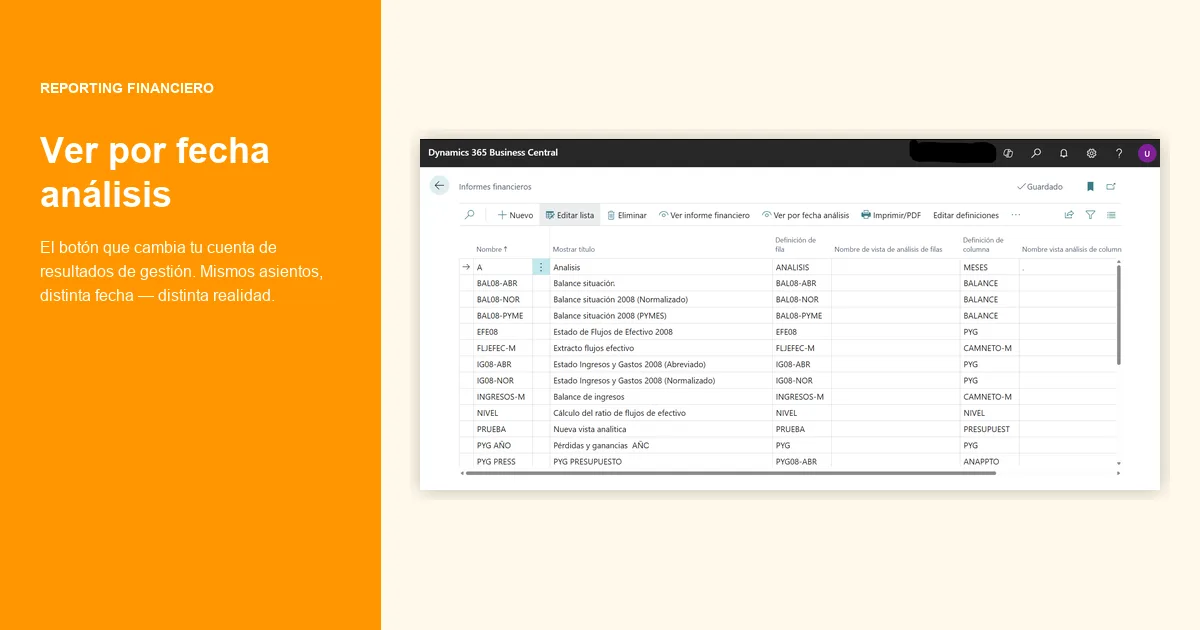
Accrual vs Invoice-based P&L Reporting in Business Central
Accrual vs invoice date in the monthly P&L: numerical examples of how monthly margins shift depending on which closing criterion you use.
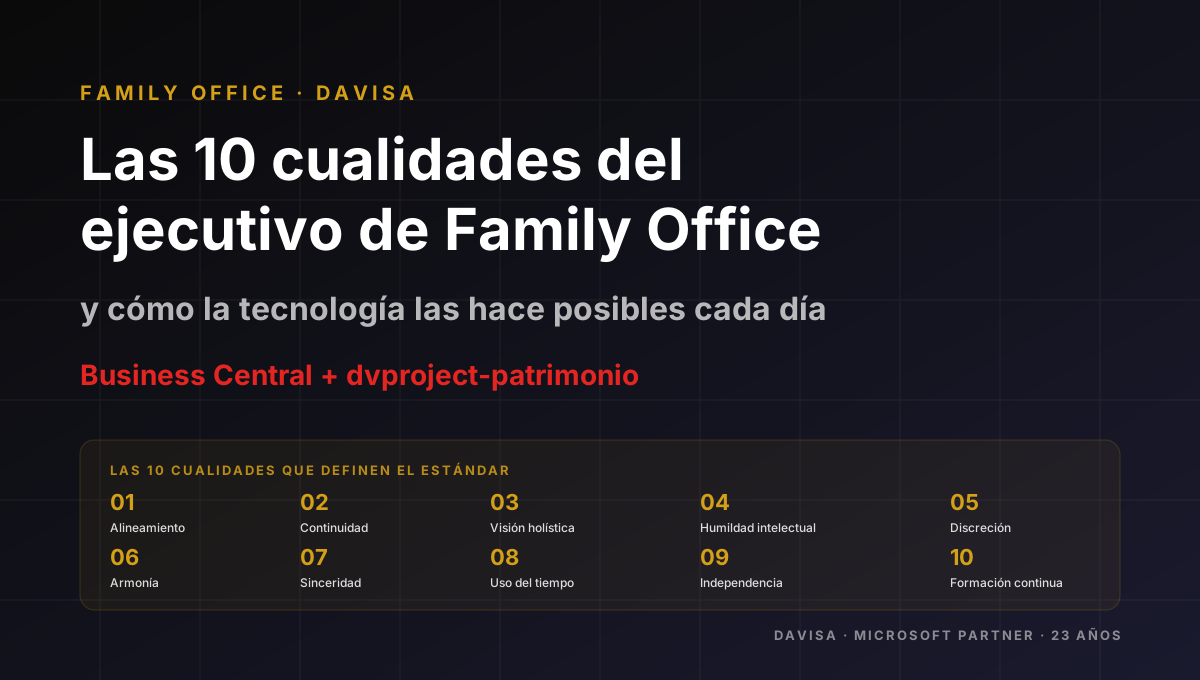
Family Office: The 10 Capabilities of an Excellent Team
Ten operational capabilities that distinguish the team of a serious Family Office, and how dvproject-patrimonio on Business Central supports them every day.

AP Automation ROI in Business Central: Real Numbers
Where AP teams burn time, the 5 ROI buckets of AP automation, real Davisa client ranges, and typical 9-14 month payback for 800+ invoices/month.